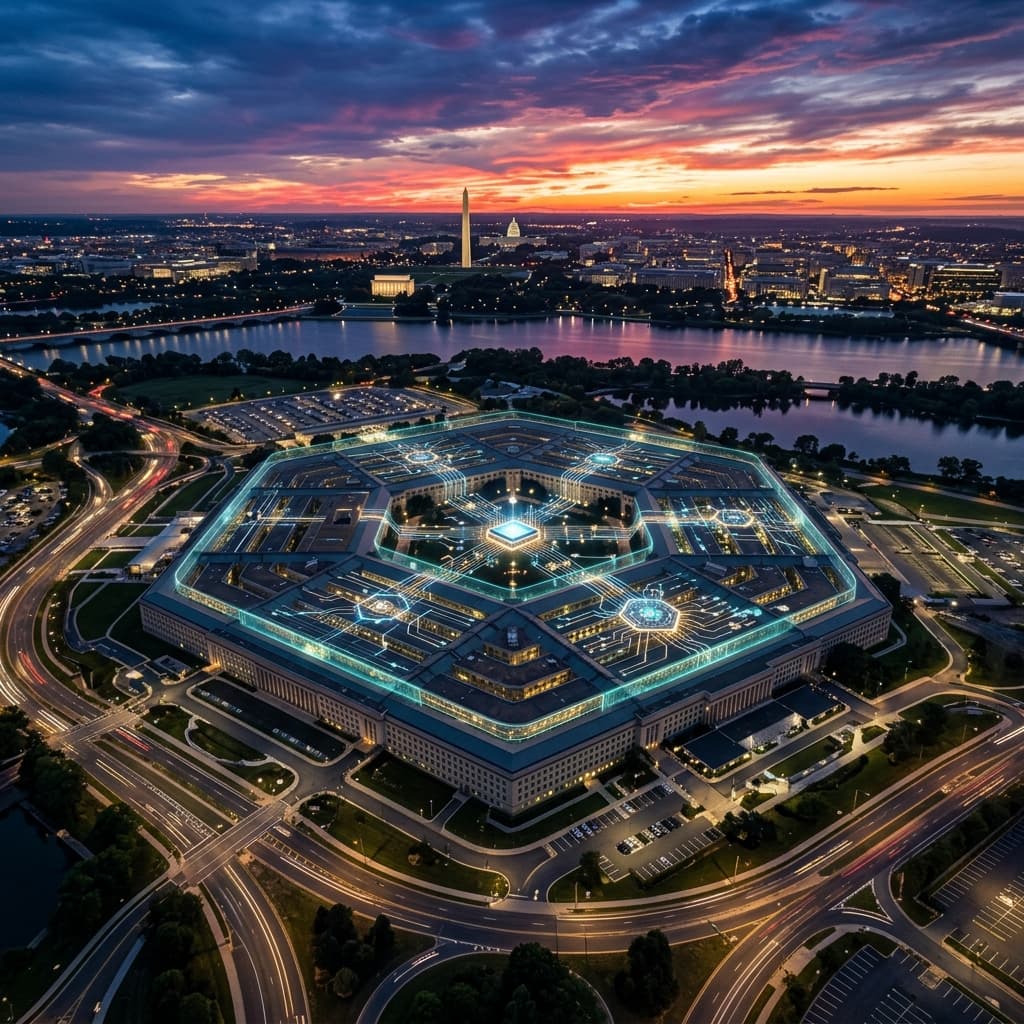

In the high-stakes world of artificial intelligence, the line between corporate labs and national security has often been blurred. But in the spring of 2026, that line didn’t just blur—it shattered. What began as a localized disagreement over API access at the Pentagon escalated into a full-scale legal and philosophical war between Anthropic and the U.S. Department of Defense (DOD), with OpenAI caught in the crossfire of a controversy that has redefined the future of AI procurement.
Context: OpenAI reached $25 billion in annualized revenue by February 2026 — in roughly 39 months, faster than any software company on record. That financial momentum is central to understanding the escalating rivalry described in this article.
The Spark: Safety Guardrails vs. Operational Urgency
The conflict traces back to February 2026, when the Pentagon sought to integrate Anthropic’s Claude 3.5 “Defense Edition” into several critical supply-chain logistics systems. Anthropic, founded by former OpenAI executives with a primary focus on “AI safety,” insisted on strict, real-time auditing of how their models were being used. They demanded that the DOD adhere to a specific set of safety guardrails designed to prevent the model from being repurposed for lethal autonomous targeting without human oversight.
The Pentagon, however, viewed these guardrails as a “supply-chain risk” in themselves. DOD officials argued that in a fast-moving conflict scenario, the latency introduced by Anthropic’s external safety checks could be catastrophic. By March, the DOD took the unprecedented step of designating Anthropic’s safety monitoring as a potential vulnerability, effectively freezing the company’s contracts.
The Lawsuit: Anthropic Fires Back
Anthropic did not go quietly. In a landmark lawsuit filed against the Pentagon, the company argued that the DOD was violating its own “Ethical AI” principles. They claimed that by bypassing safety guardrails, the government was creating a dangerous precedent for the deployment of “unaligned” systems in combat environments. The court battle became a public forum for the debate: Should AI companies have the right to pull the plug on the military if their ethics are violated?
OpenAI’s Controversial Entry
While Anthropic fought in court, OpenAI took a different path. Having recently dropped its long-standing ban on “military and warfare” applications in late 2024, OpenAI was ready to fill the vacuum. In April 2026, OpenAI signed a massive $10 billion contract with the DOD to provide “unfiltered” access to its next-generation GPT-5 models for strategic planning and logistics.
This move was met with immediate backlash from AI safety advocates and Anthropic supporters, who accused OpenAI of “selling out” the safety movement to secure government dominance. OpenAI’s leadership countered that their models were merely tools for human decision-makers and that refusing to support national defense was itself a form of irresponsibility.
The Aftermath: A Divided AI Landscape
The feud has left the AI industry more divided than ever. We now see two distinct camps: the “Safety First” camp led by Anthropic, which prioritizes ethical alignment even at the cost of government contracts, and the “Capability First” camp led by OpenAI and others, who believe that being at the center of national security is the only way to ensure AI is developed responsibly.
For the Pentagon, the lesson was clear: They will no longer tolerate “black box” oversight from vendors. Any future AI contracts now include a “sovereign control” clause, ensuring the government—not the tech company—has the final say on model behavior.
FAQ: The Anthropic-Pentagon Feud
Why did the Pentagon designate Anthropic as a supply-chain risk?
The DOD argued that Anthropic’s insistence on real-time safety auditing was a potential point of failure. If Anthropic’s servers or auditing systems went down, the military’s logistics systems would cease to function, creating a strategic vulnerability.
What was the outcome of Anthropic’s lawsuit?
As of mid-2026, the case is still tied up in appellate courts. However, it has already forced the DOD to release a New AI Ethics Framework which attempts to balance vendor safety concerns with operational needs.
Does OpenAI allow GPT-5 to be used for weapons?
OpenAI’s current DOD contract is focused on logistics, cyber defense, and strategic simulation. While it has removed blanket bans on military work, it still maintains that it does not develop “lethal autonomous weapons.”
Featured Image Credit: U.S. Navy photo, Public Domain.
Frequently Asked Questions
The dispute stemmed from competing bids and policy differences over AI safety requirements in defense contracts, with both companies taking opposing stances on deployment timelines and oversight protocols.
The Pentagon evaluates AI vendors on security compliance, model reliability, safety guarantees, and the ability to operate in classified environments—factors where Anthropic and OpenAI differ significantly.
Anthropic has maintained cautious, safety-first policies on military AI applications, emphasizing human oversight and limiting certain autonomous capabilities in defense deployments.
The Pentagon dispute does not stand alone. The Claude Code source-code leak and the 2026 AI legal accountability wave reflect the same pattern: AI companies are facing scrutiny at every level — corporate, governmental, and technical — and decisions made in one arena ripple across all others.
Yes—the rivalry is pushing the government to create clearer evaluation frameworks for AI safety, potentially setting long-term precedents for how AI contracts are awarded in national security contexts.